What Is Agentic SDLC and Why It Matters for Your Business
If your last software project ran over budget or slipped its deadline, you’re in very large company. Custom software development has always been expensive and slow — and for most businesses, that’s just accepted reality. It doesn’t have to be. Gartner projects a 30% aggregate productivity gain in software development across enterprises through 2028, driven by one shift: AI agents embedded across every stage of the build process. (Gartner, July 2025.) That shift has a name. It’s called the Agentic SDLC.
This article explains what the Agentic SDLC actually is, how it changes each stage of software development, and — most importantly — what it means for your bottom line if you’re considering a custom software project. No technical background required. If you’re already curious about AI-Driven SDLC services, feel free to jump ahead.
- The Agentic SDLC places autonomous AI agents across every phase of software development — from requirements through deployment — so humans oversee rather than execute each step.
- Organizations using AI throughout the full development lifecycle can expect 25–30% productivity gains and up to 50% reduction in time-to-market (Gartner / McKinsey estimates, 2024–2025).
- Industries including construction, manufacturing, healthcare, and professional services are already seeing measurable returns — and the global agentic AI market is projected to reach $139 billion by 2034 (Fortune Business Insights, March 2026).
First, What Is the SDLC? (A 60-Second Primer)
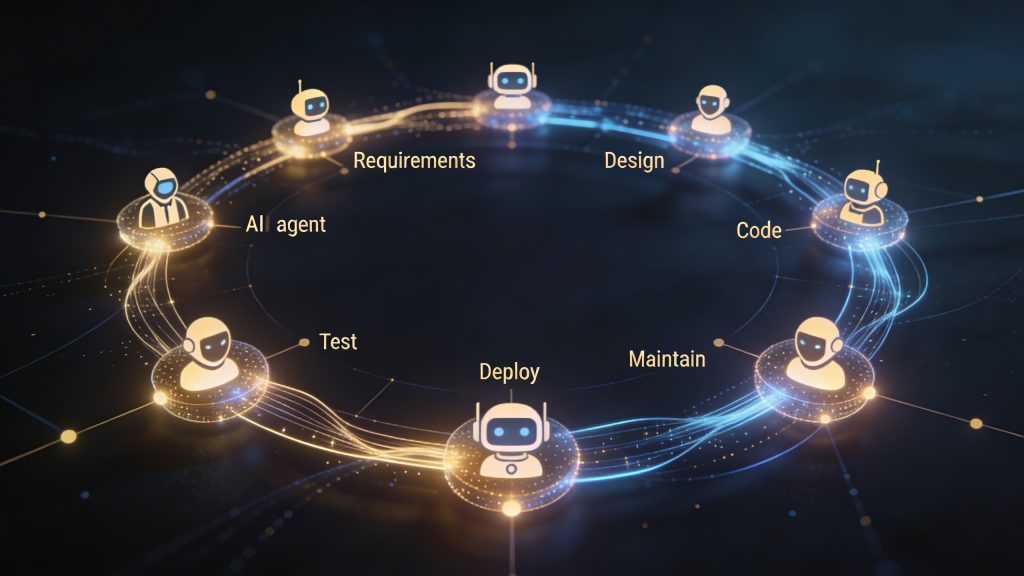
SDLC stands for Software Development Lifecycle. It’s the structured process a software team follows from the moment someone has an idea all the way through to a live product. Most teams work through six phases: requirements (defining what to build), design (deciding how to build it), development (writing the actual code), testing (making sure it works), deployment (putting it in users’ hands), and maintenance (keeping it running over time).
That process is the same whether you’re building a patient scheduling portal, an inventory management system, or a field service app. The SDLC is the roadmap. What changes — dramatically — is who does each step. And that’s exactly what “agentic” means.
What Makes an SDLC “Agentic”?
The global AI in software development market was valued at $674.3 million in 2024 and is projected to reach $15.7 billion by 2033 — a CAGR of 42.3% (Grand View Research, 2024). That growth reflects a fundamental change in what AI does on a development team. It’s no longer just answering questions.
You’ve probably heard of tools like GitHub Copilot. Copilot is an AI assistant — you write code, it suggests the next line. Useful, but it waits for a human to act first. An agentic AI is different. It can plan a sequence of steps, decide which tools to use, execute those steps, check its own results, and loop back if something went wrong — all toward a defined goal, with minimal hand-holding per step.
Think of the difference this way. An assistant gives you directions. An agent drives the car. You still choose the destination — and you can take the wheel at any moment — but you’re not doing every turn manually.
The Agentic SDLC, then, is what happens when you put those agents to work across every phase of development. AI systems that autonomously plan tasks, generate code, run tests, orchestrate deployments, and monitor production systems. Your team sets direction, reviews decisions, and stays in control. The agents handle execution.
How Do AI Agents Change Each Phase of Software Development?
Developers using GitHub Copilot — one of the most widely adopted AI assistants — completed tasks 55% faster than those working without it (GitHub Research / Microsoft Research, 2024). And Copilot is still primarily an assistant, not a full agent. Unique Insight When you extend that kind of AI support across every phase — not just code writing — the productivity math compounds fast.
Here’s what AI agents actually do at each stage of the SDLC, and what kind of impact that creates for the project overall.
| Phase | What AI Agents Do | Impact |
|---|---|---|
| Requirements | Convert stakeholder conversations into structured user stories, flag ambiguities automatically | High — eliminates weeks of back-and-forth |
| Design | Suggest architecture patterns, generate wireframes, auto-document decisions | Medium |
| Development | Generate boilerplate code, autocomplete functions, refactor legacy code | Very High — majority of time savings occur here |
| Testing | Auto-generate test suites, run thousands of edge cases overnight, triage bugs | Very High — 78% of testers report AI improves detection |
| Deployment | Orchestrate CI/CD pipelines, automate environment configuration | High |
| Maintenance | Monitor production systems, predict failures, auto-triage bug reports | High — reduces ongoing cost over time |
Sources: GitHub Research (2024); TST Technology / McKinsey (2025)
The testing phase deserves a moment. Manual testing is one of the biggest hidden costs in software development. 78% of software testers now use AI to boost productivity, and 44% of companies have integrated AI into QA workflows (TST Technology / McKinsey, 2025). AI agents don’t get tired at 4 p.m. They run edge cases overnight that a human team would take weeks to script and execute.
What This Means for Your Business — Speed, Cost, and Quality
Top-performing organizations that use AI in software development saw 16–30% improvements in time to market and 31–45% improvements in software quality (McKinsey, 2024). In business terms: your software ships faster, breaks less, and costs less to fix after launch. Here’s what that looks like on an actual project timeline. Unique Insight
| Phase | Traditional SDLC | Agentic SDLC |
|---|---|---|
| Requirements | 2–3 weeks | 3–5 days |
| Design | 2–4 weeks | 1–2 weeks |
| Development | 8–16 weeks | 4–8 weeks |
| Testing | 3–6 weeks | 1–2 weeks |
| Deployment | 1–2 weeks | 2–5 days |
| Total | 4–8 months | 8–12 weeks |
Estimates based on Gartner / McKinsey industry benchmarks (2024–2025)
Those timeline numbers aren’t theoretical. Organizations integrating AI throughout the entire SDLC can expect 25–30% productivity gains and up to 50% reduction in time-to-market compared with traditional development approaches (Gartner / McKinsey, 2024–2025). For a business waiting on a critical tool — say, an operations dashboard or a customer portal — cutting delivery from six months to ten weeks is a direct competitive advantage.
The return on investment picture is also striking. 62% of organizations using AI agents expect returns above 100% on their investments, with an average ROI expectation of 171% (Azumo, 2026). That’s a hard number to ignore when you’re evaluating whether to build custom software at all.
It’s worth noting: the Agentic SDLC isn’t just about speed. AI agents also reduce accumulated technical debt — the hidden cost of shortcuts taken during development that slow everything down later. If you’re also exploring AI automation and workflow solutions beyond just software builds, the same principles apply there too.
Which Industries Benefit Most from Agentic AI Development?
The agentic AI market was valued at $7.29 billion in 2025 and is projected to reach $139.19 billion by 2034 (Fortune Business Insights, March 2026). That kind of growth doesn’t happen in a vacuum. It’s being pulled forward by specific industries where the pain of slow, expensive custom software is most acute. Personal Experience
Construction and Field Operations
Agentic AI in construction can reduce project delays by up to 25% and cut costs by 20% (CMiC Global / Oracle, 2025). For contractors managing multiple job sites, custom software built with agentic methods can track materials, flag schedule slippage, and route approvals automatically — without a six-month development wait.
Manufacturing
Manufacturers often need custom ERP extensions or inventory management tools that their off-the-shelf software can’t handle. Agentic SDLC methods compress development timelines enough that these custom builds become economically practical for mid-size operations, not just enterprise giants.
Healthcare and Medical Practices
HIPAA-compliant portals, patient scheduling systems, and clinical workflow tools carry strict compliance requirements. AI agents can auto-generate test coverage for regulatory requirements and flag compliance gaps during development — not after deployment, when fixes are far more expensive.
Professional Services
Law firms, accounting practices, and consultancies increasingly need document automation, client portals, and billing integrations. These are exactly the kinds of repetitive, rules-based workflows where AI agents accelerate development the most. The quality improvement — fewer bugs, better test coverage — also reduces the support burden after launch.
Is the Agentic SDLC Right for Your Next Software Project?
There’s an understandable concern here: if AI agents are running parts of the development process, who’s responsible when something goes wrong? The answer is the same as it’s always been — your development team. 79% of organizations have some form of agentic AI adoption, with 96% planning to expand that use in 2025 (industry survey via Landbase, 2026). These aren’t experimental moonshots anymore. They’re standard professional practice with established governance frameworks.
Human developers still architect the system, review agent outputs, set quality thresholds, and make the judgment calls that matter. Agents handle repetition and scale. That division of responsibility is actually better governance than traditional development, where tired humans doing repetitive tasks are the primary source of error.
If you’re planning a custom software project — or you’ve got a legacy system that needs modernization — the Agentic SDLC is worth a serious conversation. It’s not a silver bullet, but it’s the most significant improvement in how software gets built in a generation.
The best first step is an honest assessment of your project scope. Schedule a free consultation and we’ll tell you plainly whether agentic methods fit your timeline, budget, and goals.
Frequently Asked Questions
What is the Agentic SDLC in simple terms?
The Agentic SDLC is software development where autonomous AI agents handle tasks across every phase — from writing user stories and generating code to running tests and monitoring live systems. Human developers guide the work and make key decisions, but they’re not doing every step by hand. The result is faster delivery and measurably higher quality output.
Do I need to understand AI or coding to benefit from the Agentic SDLC?
No. As a business owner, your job is defining what you need the software to do — your goals, workflows, and success criteria. Your development partner handles the AI tooling. McKinsey found top-performing organizations using AI in development saw 31–45% improvements in software quality (McKinsey, 2024) — better outcomes with no technical knowledge required on your end.
Which types of businesses benefit most from Agentic SDLC-powered development?
Any business building custom software benefits, but the gains are largest for industries with high regulatory complexity or tight timelines — construction, healthcare, manufacturing, and professional services. Agentic AI in construction alone can reduce project delays by up to 25% and cut costs by 20% (CMiC Global / Oracle, 2025). The same efficiency principles apply across every sector.
The Takeaway
Software development has always been one of the most expensive investments a business makes. It’s also one of the least predictable — budgets slip, timelines stretch, and products sometimes arrive already outdated. The Agentic SDLC doesn’t fix every variable, but it changes the odds significantly.
Gartner predicts 90% of enterprise software engineers will use AI code assistants by 2028, up from less than 14% in early 2024 (Gartner, July 2025). The window to get ahead of that shift — rather than scramble to catch up — is still open. Businesses that build with agentic methods now will have faster, more reliable software. And they’ll have it sooner than their competitors who are still doing things the old way.
Ready to explore what agentic software development could mean for your specific project? The WinTechnology team works with construction, manufacturing, healthcare, and professional services businesses across Southern California.
Sources
- GitHub Research / Microsoft Research (2024). “Research: Quantifying GitHub Copilot’s impact on developer productivity.” github.blog
- GitHub / getpanto.ai (2026). GitHub Copilot user base and Fortune 100 deployment data.
- GitHub (2025). AI-written code acceptance rate data.
- Grand View Research (2024). “AI in Software Development Market Size & Share Report.” grandviewresearch.com
- Gartner (July 2025). “Gartner Says AI Code Assistants Are Transforming Software Development.” gartner.com
- Gartner (August 2025). Prediction on enterprise application embedding of task-specific AI agents by 2026.
- McKinsey & Company (2024). “Unleashing developer productivity with generative AI.” mckinsey.com
- Fortune Business Insights (March 2026). “Agentic AI Market Size, Share & Forecast.” fortunebusinessinsights.com
- Landbase / Industry Survey (2026). Agentic AI organizational adoption statistics.
- Gartner / McKinsey (2024–2025). Full SDLC AI productivity and time-to-market reduction estimates.
- TST Technology / McKinsey (2025). AI adoption rates in software testing and QA.
- CMiC Global / Oracle (2025). Agentic AI impact on construction project delays and costs.
- Azumo (2026). AI agent ROI expectations survey data.